Project-Based Learning (PBL)
Investigating questions connected to everyday life, to the interests of the students and to the challenges of their surroundings.


Projects
Sumak Kawsay was born as an integral proposal where education, community and space are thought through together.
Our work therefore unfolds through three projects that complement one another: the Educational Project, the Social Project and the Architectural Project.
Each answers a different dimension of our vision, yet all share one purpose: to build opportunities for learning, growth and encounter in harmony with people, community and territory.
Educational Project
How we understand education, learning and accompaniment.
At Sumak Kawsay we understand education as a process of accompaniment. Every child and adolescent learns differently, at their own pace and through diverse experiences.
That is why we seek a personalised education, with flexible structures that allow us to attend to different learning rhythms within a single community. The National Curriculum of the Ministry of Education is our frame of reference, but learning cannot be reduced to covering content at a single speed.
We believe there are no magic formulas in education. Our work is to observe, listen, propose achievable challenges and adapt our strategies to the real needs of our students.
Our approach rests mainly on three complementary axes:
Investigating questions connected to everyday life, to the interests of the students and to the challenges of their surroundings.
We work with flexible structures, but this does not make Sumak Kawsay a free-pedagogy school. We draw on some of its resources: free play, assembly-based decision making, agreements on living together, shared responsibilities, and the progressive choice of projects and workshops.
Spaces that develop cognitive, physical, social, aesthetic, ecological, practical and personal dimensions.
Our approach draws on various pedagogical currents and inspirations, explained in greater depth in the Family Handbook.
Download the Family Handbook (PDF)Learning begins with play, observation, exploration and discovery. Inspired by Reggio Emilia, the questions, curiosity and interests of children also give rise to small projects. This way of learning naturally builds the bridge towards the project work that continues and deepens in primary school.
Projects gain more structure and students go deeper into research, reading, active mathematics, communication, collective work and the progressive taking on of responsibility. Learning stays concrete, meaningful and connected to reality, while autonomy grows.
Accompaniment evolves towards greater autonomy, critical thinking and disciplinary depth. Projects are organised by subject areas, incorporating sciences, mathematics, communication, social sciences, languages, digital skills, physical education, education for work, tutoring and experiences connected to practical life and the community.
Although the ways of accompanying change, the philosophy remains: respecting individual processes, sustaining the bond, and allowing each student to move forward with greater awareness of and responsibility for their own learning.
Frequently asked questionsIntegral formation is central at Sumak Kawsay. Our workshop programme is inspired by the School of the 7 Petals, which recognises different dimensions of the person beyond the strictly academic: body, creativity, social bonds, artistic sensibility, relationship with nature, practical skills and self-knowledge.
Art, movement, sport, languages, practical life, creation and personal development are therefore part of everyday school life.
Across all levels we run programmes that nurture life skills and run through the school experience:
Wiñay Programme
Wiñay means to grow.
To grow as a person, to grow in community, and to grow with the conviction that a sustained opportunity can transform a life and, in time, a community too.
The Wiñay Programme was born as a natural continuation of the Sumak Kawsay Social Project. After years of community work, some of the children taking part in our workshops began to say, spontaneously, that they wanted to keep studying at Sumak Kawsay. That wish made us understand that our commitment could not end when a workshop finished or when primary school was over.
That is why Wiñay exists: to accompany students who wish to continue their educational path at Sumak Kawsay and who, for financial reasons, could not do so without support.
We believe that talent, curiosity, creativity and the desire to learn do not depend on a family's financial situation.
Wiñay seeks to ensure that no student sees their educational path interrupted for lack of resources alone. We do not understand the programme as handing over an isolated scholarship, but as a process of accompaniment that lets each student keep growing, develop their potential and build new possibilities for their future.
Wiñay is sustained by a network of individuals, families, companies and organisations who choose to accompany these educational journeys.
Every contribution helps sustain the education of a student within a learning community where academic learning lives alongside art, sport, nature, critical thinking and personal development.
For us, accompanying does not mean creating dependency. It means opening an opportunity and sustaining it over time.
The programme is aimed at students connected to the Sumak Kawsay Social Project who have shown commitment, perseverance, an interest in learning and the wish to continue their education in our learning community.
Wiñay begins by accompanying students finishing primary school at the San Isidro Labrador school, but its vision is broader: in the future, to accompany both girls and boys from communities across the Sacred Valley.
We dream that no child ever has to give up learning for lack of resources alone.
We want to see them grow, finish secondary school, reach new opportunities and, in time, become people able to open paths for those who come after them.
That is the meaning of Wiñay: to grow, to help others grow, and to let that growth continue.
Architectural Project
Geometry, nature and community in the design of the school.
At Sumak Kawsay we believe that space is also part of the educational experience.
Our Architectural Project therefore does not stem only from the need to build classrooms, but from asking what kind of place we want to inhabit, how we want to feel inside it, and what relationship we want to keep with nature, culture and community.
The school has been conceived as a whole in which architecture, education and territory speak to one another.
We have currently built roughly 40 % of the total project, moving progressively towards grounds able to accompany the growth of early years, primary and secondary, without losing the identity Sumak Kawsay was born with.
At the heart of this proposal stands our Intihuatana, placed as the geometric, cultural and ritual centre of the school. More than an architectural element, it represents a point of encounter and connection with the Andean cosmovision, the territory we inhabit and the communal moments that are part of our school life.
Sumak Kawsay is still under construction. We currently have roughly 40 % of the architectural project completed, and our intention is to keep growing progressively, in line with educational needs and the real possibilities of the community.
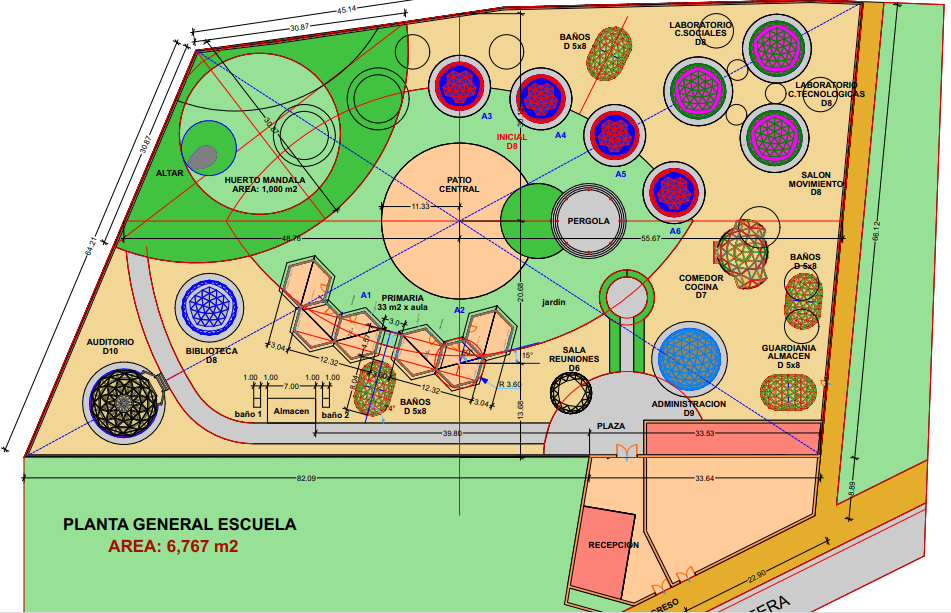
The general plan projects grounds of approximately 6,773 m² with spaces for early years, primary and secondary, plus a library, laboratory, pedagogical innovation room, multi-purpose workshop, sports areas, vegetable garden, greenhouse and gathering spaces.
The original proposal also includes an auditorium and a dome library as central spaces, linked not only to educational work but also to the social and cultural dimension of Sumak Kawsay.
To complete the development of secondary school, the project also contemplates extending onto adjoining land.
40 % built · project in development
The geometric, cultural and ritual centre of the school.
Inspired by beehives and the geometry of nature.
A hemispherical dome projected as a central reading space.
A cultural space open to the Sacred Valley.
Nature is full of structures, patterns and geometric forms. An important part of our architecture is born from that observation.
The classrooms at Sumak Kawsay are hexagonal, inspired by natural structures such as beehives, while our projected library takes the form of a hemispherical dome.
These forms were not chosen for aesthetic reasons alone. We seek to build spaces that convey harmony, that speak to the landscape, and that remind us that learning does not happen apart from its surroundings.
Architecture thus becomes an extension of our way of understanding education: flexible, connected, alive and in permanent relationship with what surrounds us.
The Architectural Project of Sumak Kawsay is based on principles of Sacred Geometry. Choosing regular forms such as the hexagon answers three dimensions that for us complement one another: aesthetic, mathematical and energetic.
From an aesthetic point of view, these forms create a sense of unity and harmony across the whole.
From a mathematical point of view, they turn the school grounds themselves into an opportunity for observation and inquiry: proportions, symmetries, polygons, measurements and geometric relationships can be part of the students’ daily experience.
And from our energetic point of view, we look for spaces that favour wellbeing and fluid circulation. To define the placement and orientation of the different areas, a Feng Shui analysis was carried out, studying the energy currents of the land. Its conclusions were incorporated into the general layout of the school.
At the geometric centre of the grounds, the Intihuatana further reinforces this search for balance between space, culture, territory and community.
From its origin, Sumak Kawsay was never conceived as a space closed off for families able to pay tuition.
The same vision that runs through our Educational and Social Projects is present in our architecture: we want the spaces we build to also serve the community.
Within our projection, therefore, lies the intention of having an auditorium or community cultural space able to host theatre, music, circus, gatherings, workshops, performances and other open activities.
Neither the library nor the future cultural spaces are imagined only for students enrolled at Sumak Kawsay, but as structures that can also support social and cultural work with the community.
We want Sumak Kawsay, in time, to be far more than a school: a meeting place where children, young people, families, artists, teachers and organisations of the Sacred Valley can learn, create and share.
Because building the school also means building community.
Write to us if you want to learn about our educational proposal, visit the school, receive information about admissions, talk about the Social Project, or explore possible partnerships and ways of collaborating.
Social Project
Never closing the door for financial reasons
Scholarships, accompaniment and community programmes open to the Sacred Valley.
What the Social Project is
The Social Project is part of the very origin of Sumak Kawsay.
From the moment the school was born we were clear that we did not want to build a bubble inside the Sacred Valley, nor become a space accessible only to families able to cover the full cost of a private education.
Even when Sumak Kawsay was just starting out and had very few resources, we decided to open our doors to children from the community through full scholarships.
As the school grew we also came to understand the financial limits of sustaining a system based exclusively on 100 % scholarships. Without permanent external funding, we built other routes of access: half scholarships, partial scholarships and fee reductions for families who wanted to be part of Sumak Kawsay but could not cover the full tuition.
That is how we understand our Social Project: as a commitment never to close the doors of our learning community for financial reasons alone.
A commitment that grew with the school
As Sumak Kawsay grew, so did our commitment to our surroundings.
During 2025 the school forwent roughly S/ 80,000 in scholarships, discounts and fee reductions for Sumak Kawsay students. In 2026 that effort amounts to approximately S/ 110,000.
These resources could have gone entirely towards accelerating the construction of our infrastructure. From the beginning, however, we chose to grow differently: step by step, seeking a balance between the development of the school and the opportunities we can sustain for those around us.
In 2024 we understood that, although scholarships and reductions opened the doors of Sumak Kawsay to more families, our reach was still limited.
We therefore decided to extend the Social Project towards the community and create free spaces for art, sport, socio-emotional accompaniment and educational support.
Since then the project has grown into a sustained community programme that strengthens the bond between Sumak Kawsay and the communities around us.
Current lines of action
Scholarships, discounts and fee reductions
From the very beginning we have created different routes of access for families who wish to join our learning community but cannot cover the full cost. We seek to sustain a diverse community where financial circumstances are not the only criterion for access.
Art for Life
Free workshops in circus, theatre, music and artistic expression, where art works as a tool to strengthen confidence, autonomy, creativity, expression and a sense of belonging.
Sport and women's football
Spaces that foster teamwork, discipline, personal confidence and new opportunities for girls and adolescents.
Socio-emotional accompaniment
Psychology and socio-emotional development spaces focused on wellbeing, emotional expression, relationships and the personal resources of students.
Educational support and reinforcement
Actions to strengthen learning, accompany different rhythms and offer tools that help students stay in school.
Integration between schools and community
Shared activities between Sumak Kawsay students and students from community schools, especially San Isidro Labrador de Sillacancha, to learn, play, create and grow together.
Impact on the community
Our social commitment is also reflected inside Sumak Kawsay.
Scholarships, discounts and fee reductions
Income Sumak Kawsay chose to forgo in tuition in order to sustain scholarships and discounts for students of the school itself.
Community programme
Free workshops in art, sport, socio-emotional accompaniment and educational support, open to the communities around us.
This is not money handed to other institutions or allocated to external programmes. It is income that Sumak Kawsay chose not to collect so that children and adolescents could keep studying and stay within our learning community.
These two lines — opening the doors of the school and widening opportunities beyond it — express one and the same decision: to grow without disconnecting from our surroundings.